Essay · Just for fun
Can Rain Power a Country?
A playful what-if: could a nation run on the energy in its rainfall?
Late one night I watched a video of someone generating electricity from rainwater collected off his roof. Barely enough to light a single LED. But it got me thinking: what if you scaled it up? Every roof in a country, treated as national infrastructure rather than a hobby project.
Absurd, for most of the world. But run the numbers and a handful of countries land in a sweet spot where the arithmetic is surprisingly close to working.
The Physics
The energy in falling water comes down to three things: how much, how far it falls, and how efficiently you capture it. Mass times gravity times height, high-school physics. For a single roof I assumed a generous 269 square metres of collection area and a 10-metre drop through a micro-turbine: the most energy a year of rain could yield.
E = m × g × h
For one house, even in the wettest places on Earth, the result is underwhelming. The Solomon Islands, over 3,000 millimetres of rain a year, manage roughly 22 kilowatt-hours from one rooftop. Colombia, one of the wettest countries on the planet, about 24 kWh. Your phone charger uses more than that in a year.
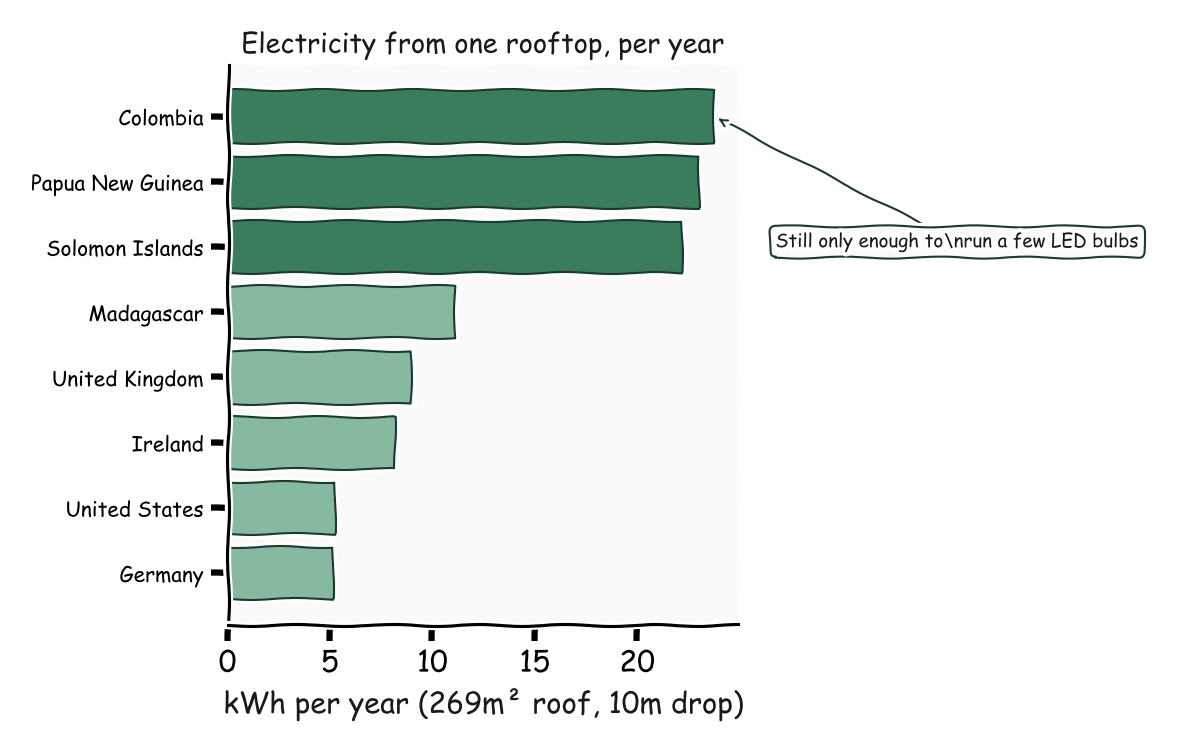
Annual electricity yield per rooftop across the world’s wettest countries: enough for a few LED bulbs.
This is where most people stop. One roof cannot power a house. The idea is dead.
Except It Is Not Dead
The real question is not whether one roof can power one house, but whether all the rain falling on a country, run through turbines at scale, could contribute meaningfully to its electricity supply.
That swaps the denominator from household to national consumption, and some countries use very little. The Central African Republic uses about 200 million kWh a year, roughly a single large data centre. Guinea-Bissau uses even less: 32 million kWh.
Divide a country’s total rainfall energy by its electricity consumption and a pattern emerges. For the Central African Republic, rain on just 2.4% of the land could produce 10% of the nation’s electricity. Guinea-Bissau needs 7%, the Solomon Islands 9%.
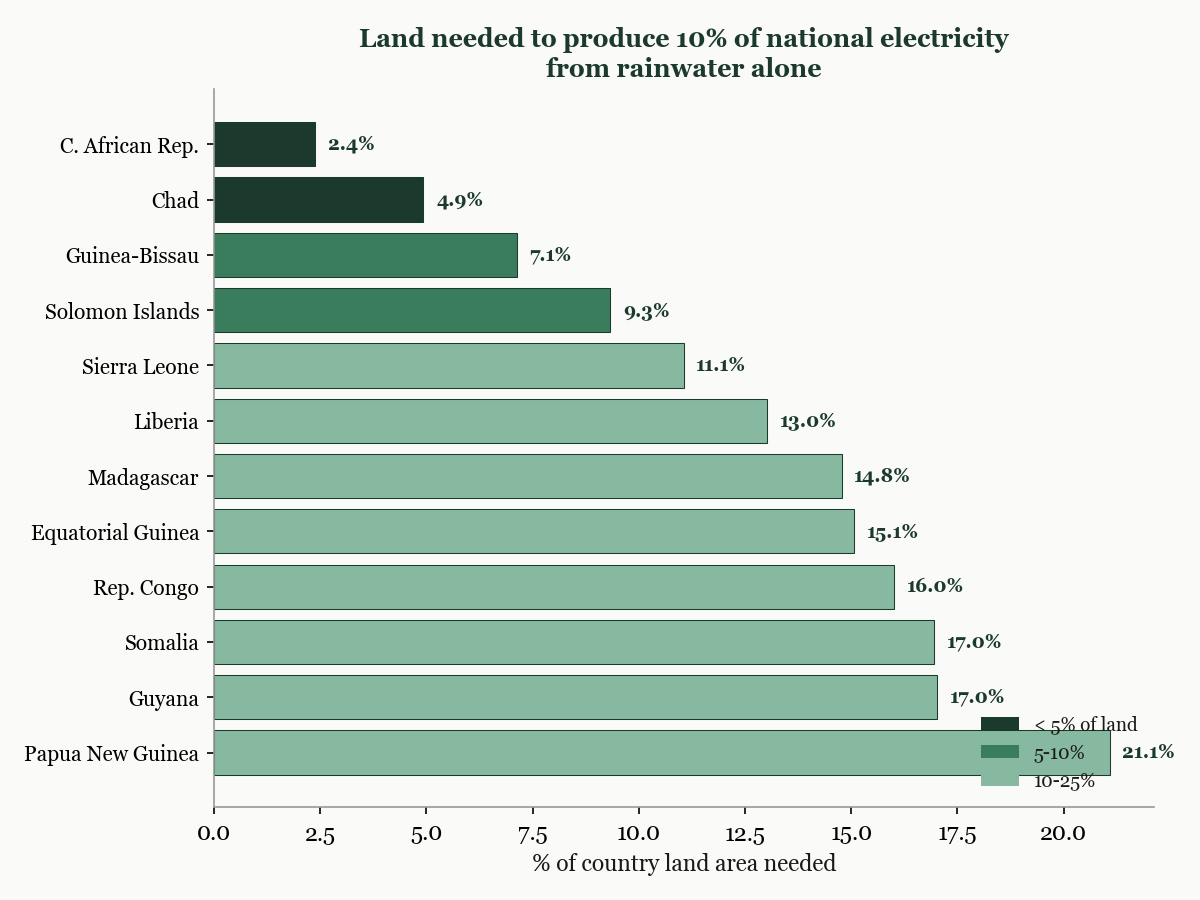
Percentage of national land area needed to cover 10% of electricity from rainfall collection.
The Sweet Spot
The countries where this works share two traits: high rainfall and low consumption. Neither alone is enough. Colombia has extraordinary rainfall but consumes too much. Chad has very low consumption but not enough rain. The sweet spot sits in the bottom-right of a scatter plot: lots of rain, very little demand.
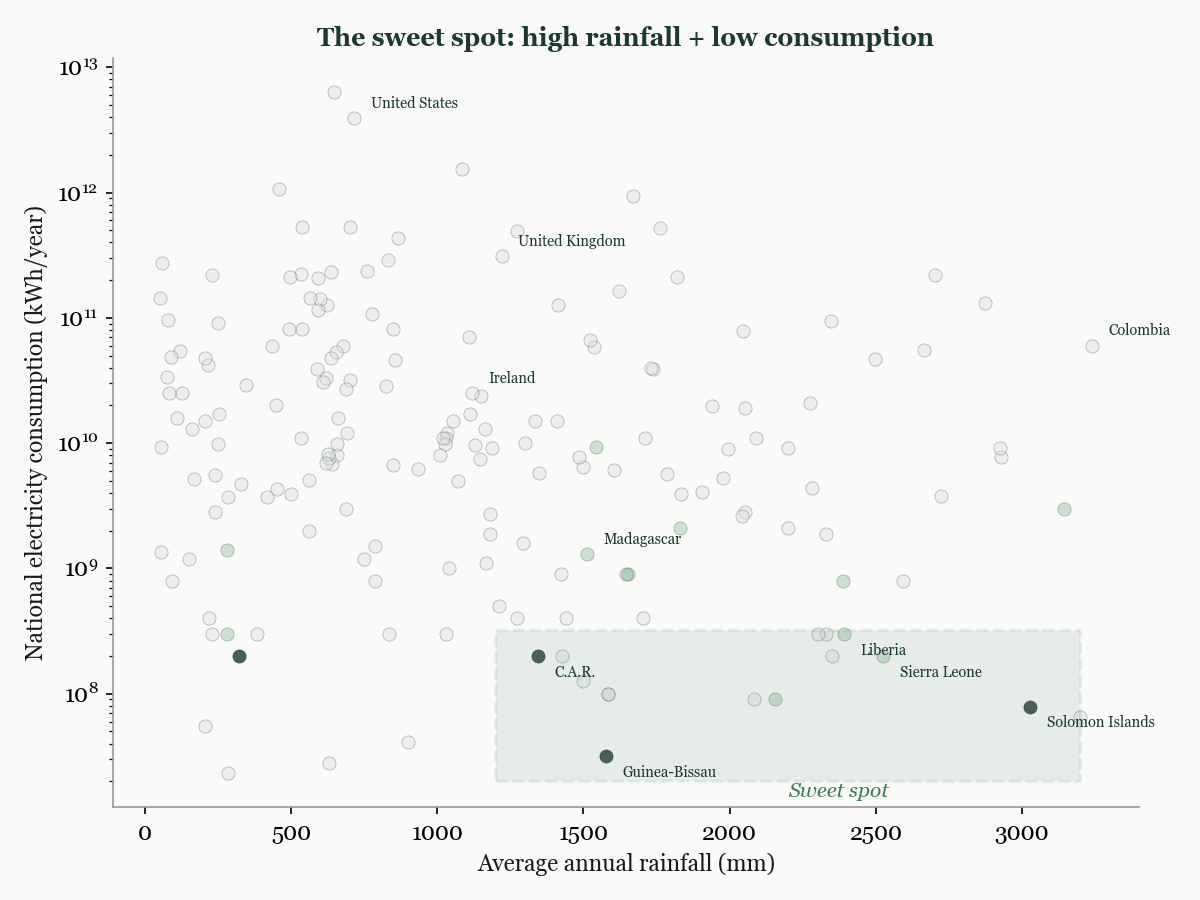
The sweet spot: high rainfall meets low national electricity demand, bottom-right of the scatter.
The most extreme case is the Central African Republic: collect all its rain and three months of it would power the country for a year. Guinea-Bissau takes about eight months, the Solomon Islands eleven.
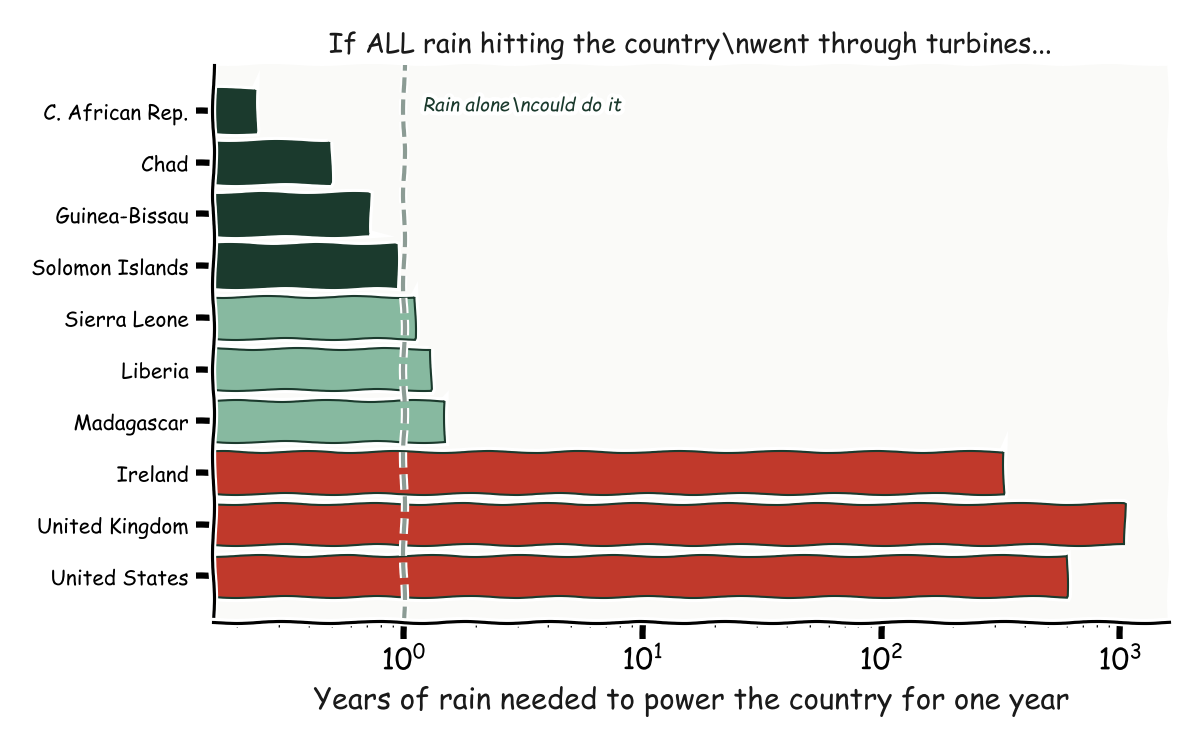
Years of full-country rainfall needed to power one year of national electricity (log scale).
Ireland would need 325 years of accumulated rain to power one year of electricity, the United Kingdom over a thousand. The gap is not about rainfall. It is about how much the country consumes.
Is This Practical?
Not really. That 2.4% of the Central African Republic is nearly 15,000 square kilometres, ten times the size of London. The cost would be extraordinary, micro-turbines at this scale do not exist, and seasonal rainfall would make supply inconsistent. The same land covered in solar panels would generate far more.
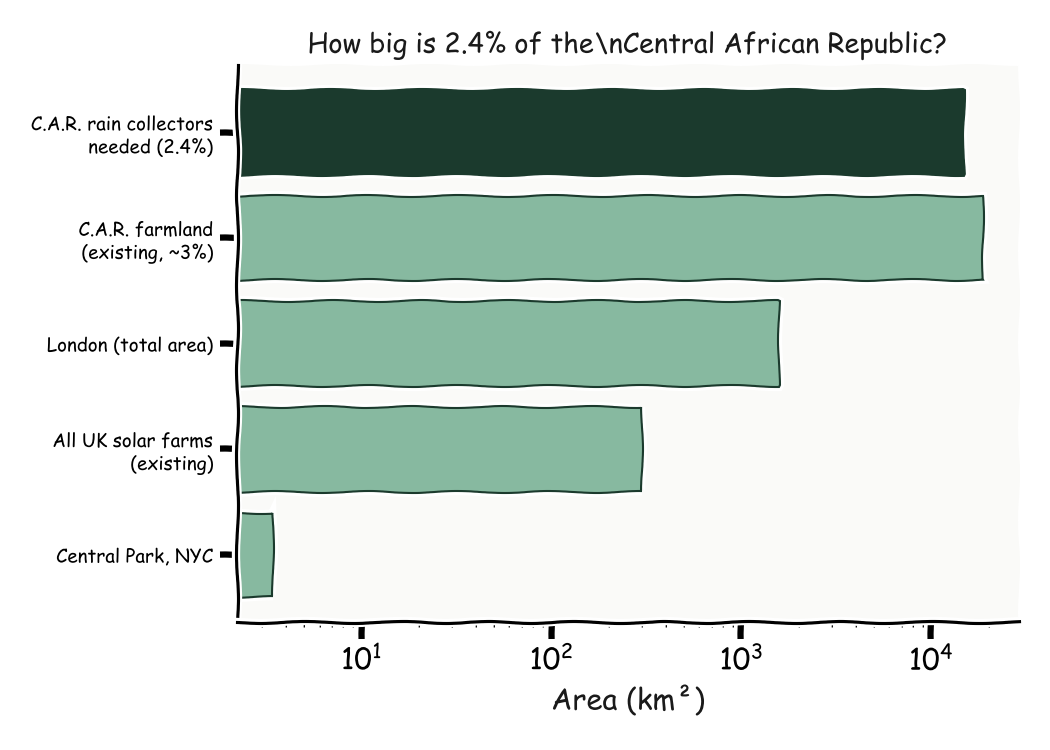
15,000 km² in context: ten times the size of London, but just 2.4% of the Central African Republic.
But that misses the point of the exercise.
What This Actually Shows
The point is not a policy recommendation, but what happens when you follow a seemingly absurd question to the end. The idea works somewhere, and not where you would guess: not the wettest places, but the intersection of rainfall and demand.
That kind of sweet spot, visible only when you cross two variables, is exactly what data analysis exists to find. Most of the time the answer is “no, this does not work.” Occasionally it is “no, except here, and the reason is interesting.” Those are the ones worth chasing.